No power in the house? It usually comes down to one of three things. The local network is down, a switch on your fuse board has tripped, or there’s a fault in your own wiring. A few minutes of checking tells you which one, and who you need to call.
That matters because each problem has a different owner. ESB Networks looks after the supply up to your meter. Everything after the meter, from the fuse board to the last socket, is the homeowner’s responsibility.
This guide runs through the checks in the order an electrician would do them. You’ll rule out the simple causes safely and know which signs need a professional straight away.
Is No Power in House a Network Fault or Your Own Electrics?
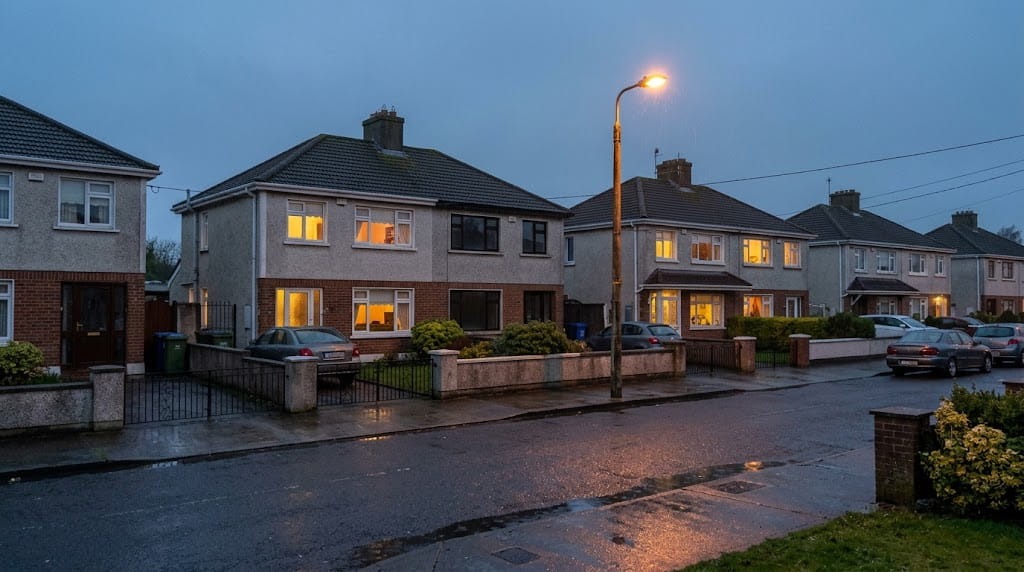
Look outside first. If your neighbours and the streetlights are also dark, it’s almost certainly a network fault, and ESB Networks will restore it. If everyone else on the road has power, the problem is inside your home.
Use these checks to confirm it:
- Neighbours and streetlights. A quick look out the window or a text to the house next door settles most cases in seconds.
- The PowerCheck map. ESB Networks runs a live PowerCheck outage map that lists known faults and planned work in your area with real-time updates.
- Report it if it isn’t listed. You can log the fault on PowerCheck or call ESB Networks 24/7 on 1800 372 999. Have your MPRN or Eircode ready.
If your neighbours have power, ESB Networks advises checking your trip switches and fuses next. A fault in your own wiring isn’t something they’ll repair, because inside the home they’re only responsible for the meter.
How to Check Your Fuse Board When the House Has No Power
Open the fuse board and look for any switch in the down or off position. When the whole house is out, the culprit is usually the main switch or an RCD, because each of those controls several circuits at once.
Smaller circuit breakers (MCBs) only cut one circuit. So if just the kitchen sockets or the upstairs lights are out, check those switches first. Our guide to what an RCD, MCB and RCBO each do explains the difference if your board has a mix of them.
How to Reset a Tripped Switch on Your Fuse Board
Switch off appliances first, then push the tripped switch firmly back up. ESB Networks gives the same advice, because resetting with everything still connected can trip it again straight away.
The steps are:
- Turn off or unplug appliances, especially heaters, kettles, washing machines and the electric shower.
- With dry hands and a torch if needed, push the tripped switch fully to the on position.
- If it holds, switch appliances back on one at a time.
- If it trips the moment a particular appliance comes on, leave that appliance unplugged and get it checked.
- If it won’t stay on even with everything unplugged, stop and don’t keep forcing it.
A switch that trips once during a storm or because of a faulty kettle is the protection doing its job. One that keeps tripping is a different problem, and our post on why a trip switch keeps tripping covers the usual causes.
Older Fuse Boards With Rewireable or Cartridge Fuses
If your board has fuse carriers instead of switches, a blown fuse often looks no different from a good one. That’s a sign of an older installation, and unless you know exactly which fuse has gone and its correct rating, leave it to an electrician.
Boards like this often have no RCD protection either. That’s the main reason many homeowners book a modern fuse board upgrade after an outage scare like this one.
What to Check When the Fuse Board Looks Fine but There’s Still No Power
If every switch is on and your neighbours have power, check the meter next. A pay-as-you-go meter that has run out of credit will cut your supply. A blank meter display with every switch on can point to a problem with the supply coming into the house.
Work through these:
- Pay-as-you-go credit. Top up and follow your supplier’s instructions to restore the supply.
- The meter display. A dead screen on the meter suggests power isn’t reaching your home. ESB Networks is responsible for outages up to the metering point, so report it to them.
- Planned work. ESB Networks posts notice at least two working days before a planned interruption, so check for a letter you may have missed.
- Storm damage. A damaged overhead line or service cable is a network job. Never approach fallen wires.
If the meter is lit, credit is fine and the board is all on but sockets still don’t work, ESB Networks recommends contacting a registered electrical contractor. At that point the fault is somewhere in your wiring.
Partial Power in the House and What Each Pattern Means
The pattern of what’s working tells you a lot. Which circuits are dead, and how the remaining lights behave, narrows the fault down before anyone opens up the board.
- One room or one set of sockets out. Usually a single tripped breaker, or a loose connection at a socket or junction box on that circuit.
- Lights out but sockets working (or the reverse). Lighting and power run on separate circuits. Check that circuit’s breaker, and if it’s on, the fault needs tracing.
- Lights dimming or glowing oddly bright across the house. This can point to a loose main connection or a supply problem. Turn off sensitive electronics and get it checked the same day.
- Everything works except one appliance. The fault is most likely the appliance itself or the fuse in its plug.
Warning Signs That Mean You Should Stop Checking and Call for Help
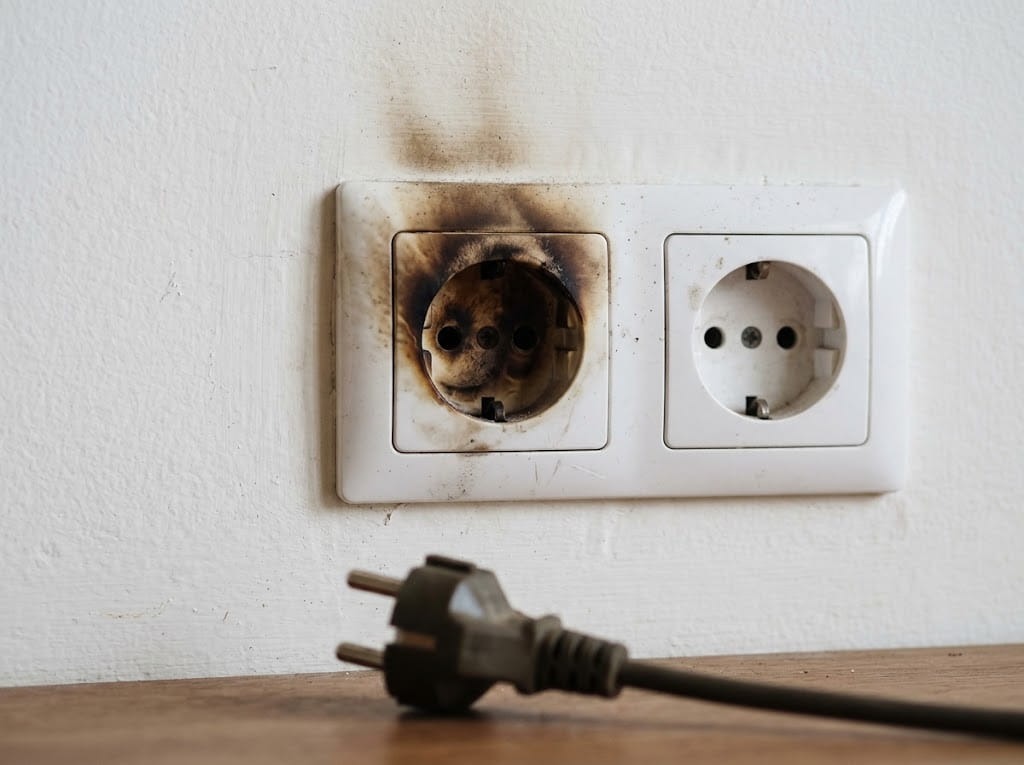
Stop straight away if you notice any sign of heat, burning or damage. These point to a fault that resetting a switch won’t fix, and repeated resets can make it worse.
- A burning smell, or scorch marks on the fuse board, a socket or a switch
- A fuse board or socket that feels warm, or buzzes and crackles
- A switch that trips instantly every time, even with everything unplugged
- Water near the fuse board, sockets or light fittings after a leak or flood
- Fallen or damaged overhead lines near your home (keep well clear and call 1800 372 999)
If there’s smoke or fire, get everyone out of the house and ring 112 or 999 first.
When to Call an Electrician About No Power in Your House
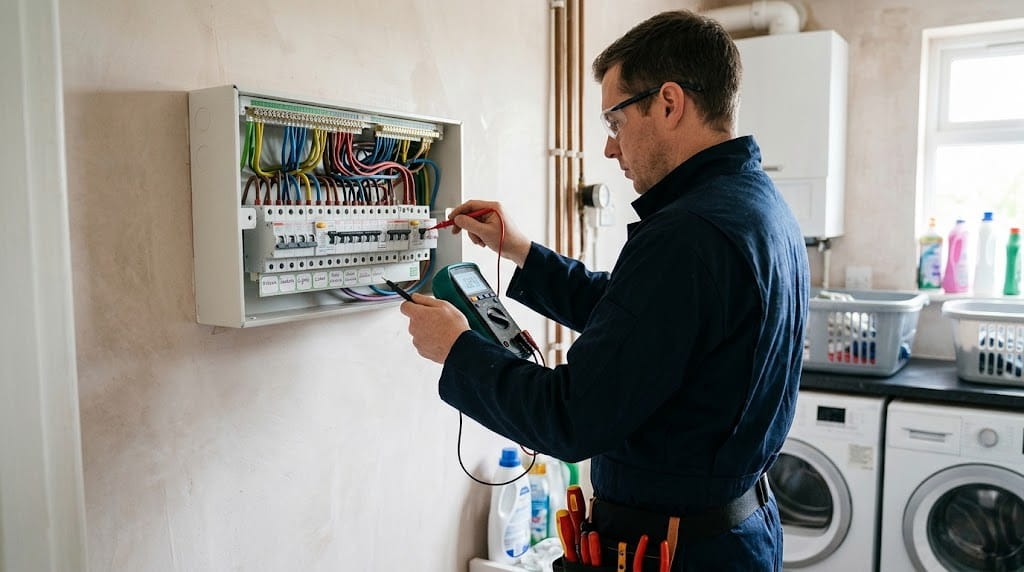
Call an electrician when your neighbours have power, your meter is working, and the fuse board won’t reset or looks fine while circuits stay dead. That’s an internal fault, and ESB Networks won’t repair wiring inside your home.
By law in Ireland, electrical work in a home must be done by a Registered Electrical Contractor on the Safe Electric scheme. The CRU’s guidance on electrical works in your home also says you should receive a completion certificate once the work is finished.
You’ll get a faster fix if you can tell the electrician:
- Whether your neighbours have power
- Which switches tripped and whether they reset
- What was running when the power went
- Any smell, sound or scorch marks you noticed
- Roughly how old the fuse board is
We’re Safe Electric registered (A4712), and every repair comes with a certificate of compliance, so you have proof the fault was fixed properly.
Getting Power Back in Your House Safely
Most outages are solved by the first two checks. Either the network is down and ESB Networks is already on it, or a switch has tripped and resets once the faulty appliance is unplugged.
If the checks point to your own wiring, or you’ve spotted any warning sign, don’t keep resetting. Call our 24/7 emergency line on (01) 697 1995 and we’ll talk you through it and get an electrician out across Dublin and nearby parts of Kildare, Meath and Wicklow.