RCD vs MCB vs RCBO: What Each One Does in Your Fuse Board
Here is the short version. An MCB protects your wiring and appliances from too much current, an RCD protects you from a potentially fatal electric shock, and an RCBO does both jobs in a single unit. If you have ever opened your fuse board, looked at the rows of switches, and wondered what they actually do, this guide explains each one in plain English and shows you why the differences matter.
What is a fuse board?
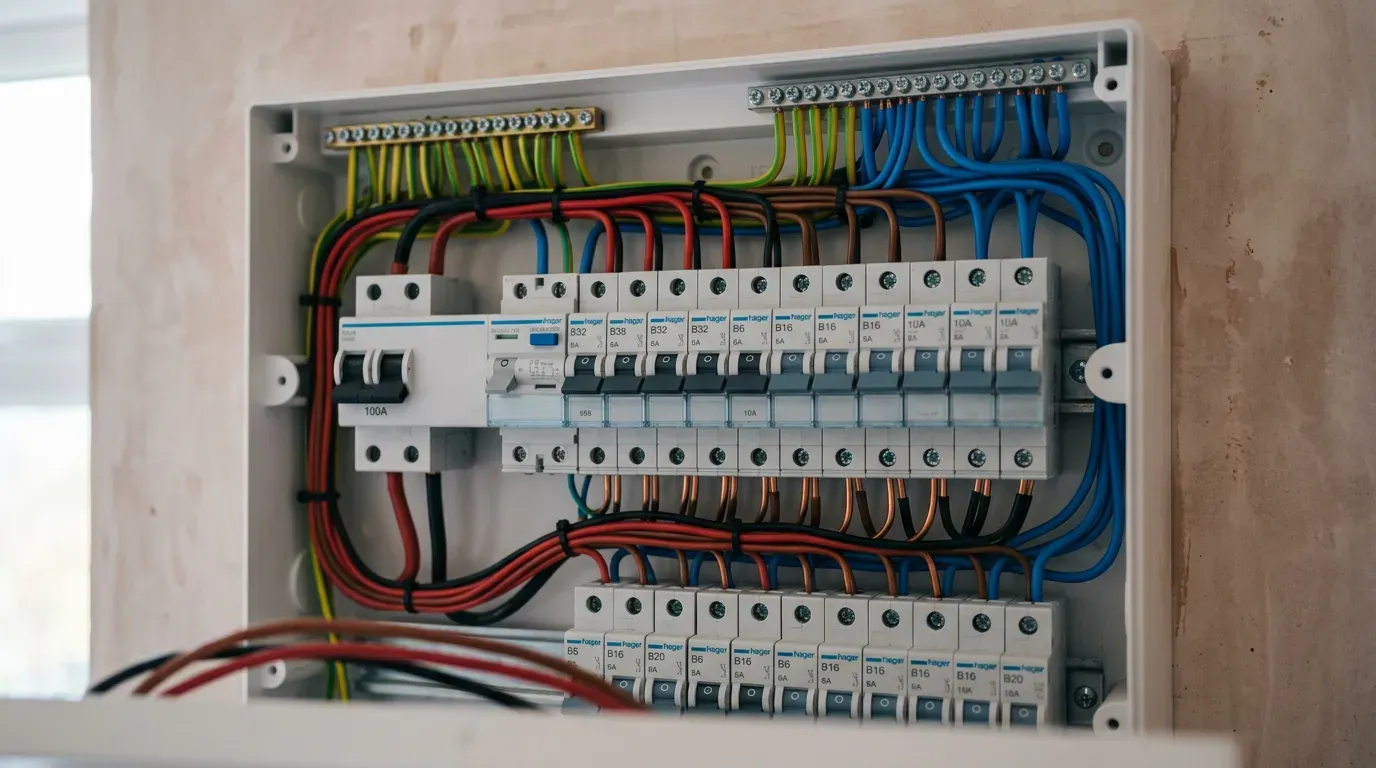
Your fuse board, properly called a consumer unit, is where the electricity coming into your home is split into separate circuits and protected. Every switch inside it is a protective device with a specific job: to cut the power automatically the moment something goes wrong, before it can damage your appliances, set wiring on fire, or injure someone. The three devices you are most likely to find are the MCB, the RCD, and the RCBO. They are not interchangeable, and knowing the difference tells you a lot about how safe your installation really is.
Does an MCB protect you from a shock?
MCB stands for Miniature Circuit Breaker. Its job is to guard against too much current flowing through a circuit, which happens during an overload (too many things drawing power at once) or a short circuit (a fault where current finds a shortcut).
An MCB is an automatic switch that constantly senses the current passing through it. The moment it detects an abnormal surge, it disconnects, breaking the circuit before the cable can overheat. In simple terms, the MCB looks after your wiring and your appliances.
The important limitation: an MCB does not protect against an earth fault, and on its own, it will not save a person from an electric shock. It is there to protect the installation, not the human touching it.
Could an RCD save your life?
RCD stands for Residual Current Device. This is the one that protects people. It works by continuously comparing the current flowing out through the live conductor with the current returning through the neutral. In a healthy circuit, those two figures match.
If some of that current starts leaking to earth, for example, through a person who has touched a live fault, the balance is broken. The RCD senses that imbalance instantly and cuts the power in a fraction of a second, fast enough to prevent a fatal shock. It is your last line of defense against electrocution.
The trade-off mirrors the MCB. An RCD on its own does not protect against overload or short circuit. It watches for current leaking where it should not, not for too much current overall.
Why is an RCBO the best of both?
RCBO stands for Residual Current Breaker with Overcurrent, and it is the best of both. A single RCBO combines the functions of an MCB and an RCD in one device. It trips if a circuit is overloaded or short-circuited, and it trips if it detects current leaking to earth. In other words, one unit protects both your wiring and the people using it.
Because an RCBO delivers this combined protection on a single circuit, it is the modern standard for a well-protected consumer unit.
RCD vs MCB vs RCBO at a glance
Device Protects Against What It Protects: MCB, MCB MCBOverload and short circuit Your wiring and appliances' RCD Earth leakage and residual current People, from electric shRCBO: Both of the above Both wiring/appliances and people
The simplest way to remember it: the MCB guards the cables, the RCD guards the person, and the RCBO guards both.
Which protection does your home actually need?
Your home needs both kinds of protection: against excess current and against earth leakage, which is what Ireland's national wiring rules, I.S. 10101, are built around. The question is how that protection is arranged in your board.
Older installations often relied on a row of MCBs sitting behind one or two shared RCDs, where a single RCD covers several circuits at once. The problem is that one earth fault can trip the whole group, which is why a single fault sometimes plunges half the house into darkness, and it makes tracking down the cause harder.
A modern approach uses an RCBO on each circuit, so every circuit has its own combined protection. A fault on one circuit then trips only that circuit and leaves the rest of the house running, which is both safer and far easier to diagnose.
How can I tell what is in my fuse box?
You can get a rough idea by looking, though only a qualified electrician should ever open or work on the unit itself. As a guide, a plain switch protecting a single circuit is usually an MCB, a wider device with a test button serving a whole row of circuits is typically an RCD, and a single-width switch with its own test button is generally an RCBO.
A few signs it is worth having a registered electrician take a closer look:
- Your board has no test buttons at all, which can mean there is no RCD protection in place
- A breaker trips repeatedly for no obvious reason
- You still have an old rewireable fuse board rather than modern breakers
- You are planning work such as an extension, a kitchen upgrade or an EV charger