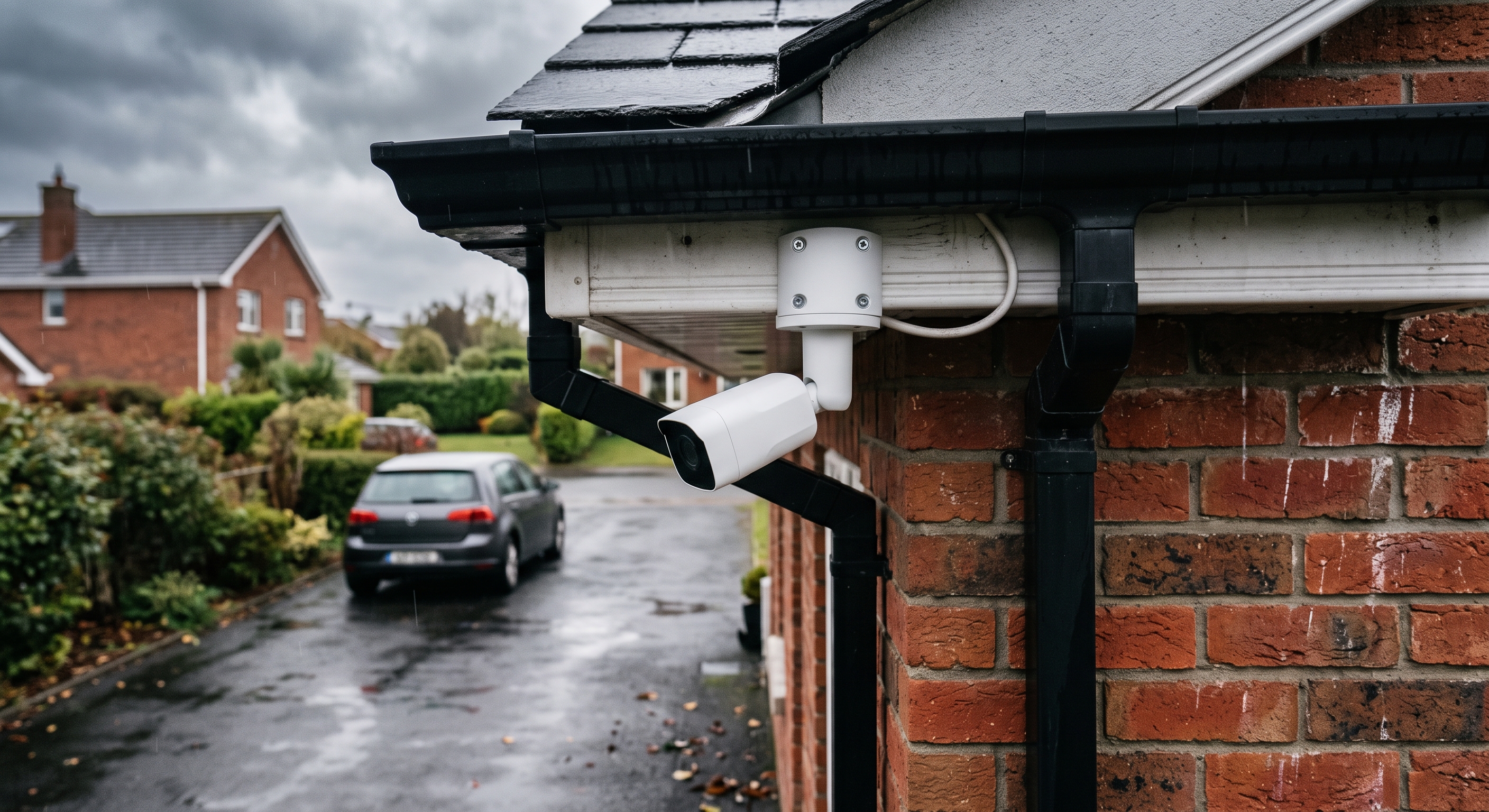
Wireless outdoor security cameras work well on most Irish homes, as long as the wifi actually reaches the mounting point and the housing is rated for driven rain. Get those two right and everything else is straightforward.
The word wireless does a lot of heavy lifting in the marketing. Most cameras sold as wireless are wireless for data only, so they still need a mains supply or a battery that somebody has to climb up and swap. Knowing which type you're buying changes where you can put it, what it costs to fit, and how often you'll be thinking about it afterwards.
This guide covers the camera types, where to mount them on a typical Irish house, what our weather does to them, what data protection law allows, and roughly what a fitted system costs.
How Wireless Outdoor Security Cameras Work on Irish Homes
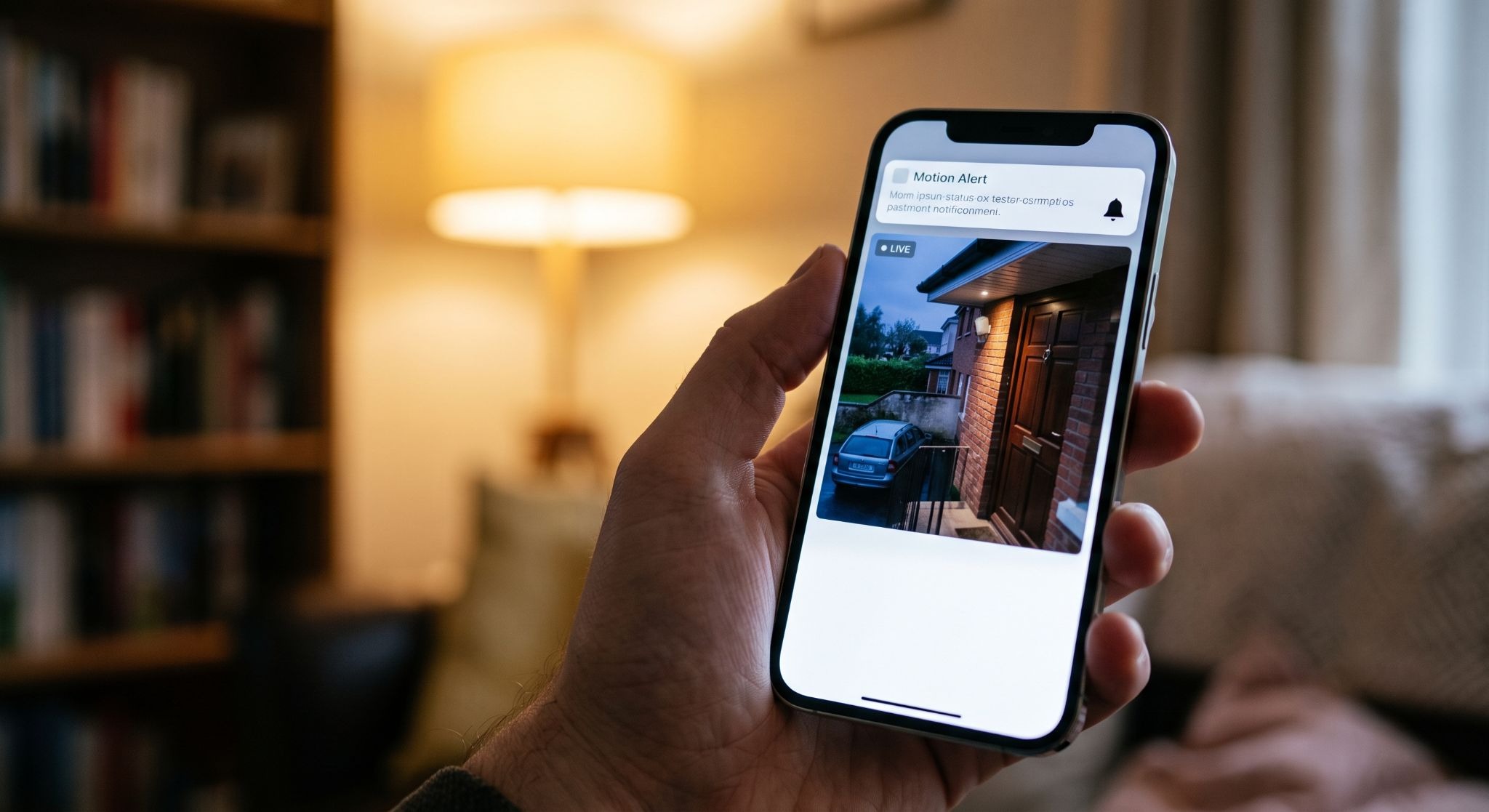
Outdoor cameras sold as wireless send footage over your home wifi rather than a data cable. Power is a separate question entirely. Some plug into a socket, some run on a rechargeable battery, and only the fully wire-free models have no cable at all.
That split decides most of the install. Three formats cover almost everything on sale here.
- Wifi cameras with mains power. Fixed to a wall or soffit and fed from a nearby socket or a fused spur. Constant recording, no batteries, but the power route has to exist or be created.
- Wire-free battery cameras. No cable at all. They record in bursts when motion triggers them, which is why battery life is measured in months rather than years of continuous footage.
- Wired PoE cameras. Not wireless, but worth knowing as the comparison. One cable carries power and data, which suits sheds, gates and anywhere wifi struggles.
Battery Cameras vs Mains Powered Wifi Cameras
Battery cameras win on placement, mains cameras win on reliability. A battery unit goes anywhere you can reach with a drill. A mains unit records continuously and never goes flat in the middle of January.
Pick a battery if the spot has no realistic power route, or if you're renting and need to take it with you. Pick mains if the camera is covering a front door, driveway or side passage that matters, because those are the views you cannot afford to have offline.
Where Footage Gets Stored on a Wireless Camera System
Wireless cameras store footage in one of three places, and each has a different running cost. Local storage is free but sits on the premises. Cloud storage survives a break-in but usually carries a subscription.
- MicroSD card in the camera. Free, simple, and gone if the camera is stolen or smashed.
- Cloud plan. Footage held off-site, typically a few euro per camera each month, with alert history and longer retention on the paid tiers.
- Local NVR or hub. A recorder in the house that pulls in several cameras, better for a full home CCTV system rather than one or two standalone units.
Most households end up mixing the two, with a card in each camera and a cloud plan on the cameras covering the entrances.
What You Need Before Installing Outdoor Cameras
Five things decide whether an install goes smoothly, and all of them can be checked in twenty minutes before you buy anything. Test the wifi at the exact mounting point first, because that single check prevents the most common disappointment.
- Wifi signal at the mounting spot. Stand where the camera will go, hold your phone against the wall and run a speed test. Two bars inside the hall means nothing.
- Broadband upload speed. Live viewing and cloud backup use upload, not download. Several cameras streaming at once will find the ceiling quickly.
- A power source. An existing outdoor socket, a spur off a ring, or an accessible internal route. Battery only if none of those work.
- A storage decision. Card, cloud, recorder, or a combination, agreed before you fit anything.
- A boundary check. Walk the property line and note what each proposed view will actually capture.
If you're planning cameras alongside an alarm, it's worth looking at home alarm and CCTV installation as one job rather than two, since the mounting points and the cabling often overlap.
Where to Mount Outdoor Security Cameras on an Irish House
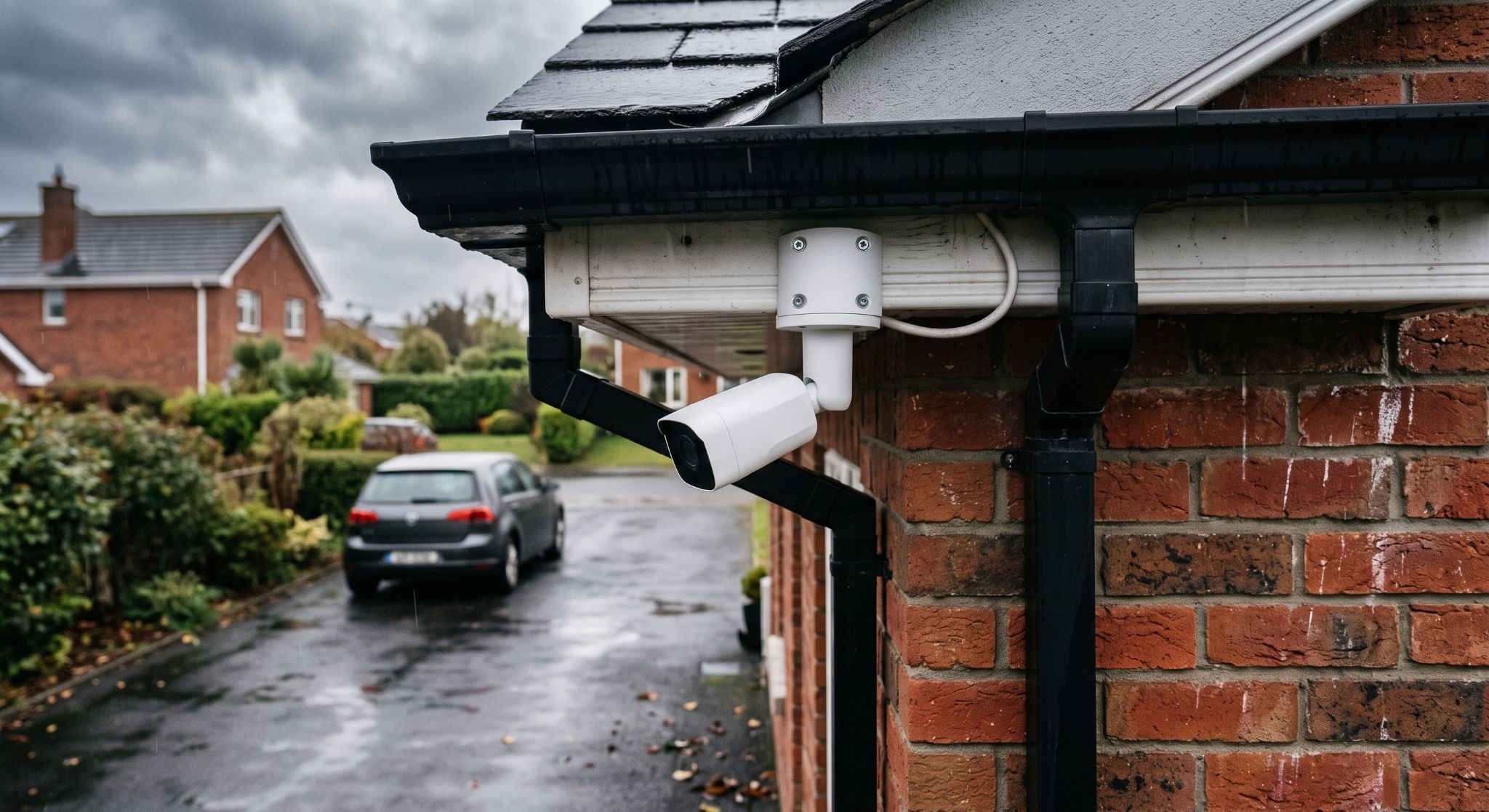
Mount cameras high enough to be out of reach, under cover where possible, and angled down across an approach rather than straight out at the boundary. Around 2.5 to 3 metres is the usual working height, high enough to deter interference and low enough to still get a usable face.
On a standard semi or detached house, four positions cover most of the risk.
- Front door or porch. Catches callers and deliveries. Keep it under the porch roof or eaves so rain runs past the lens rather than across it.
- Driveway or gate. Angle along the drive towards the house, not out towards the road, which keeps the footage useful and the capture area tighter.
- Side passage. The most common access route to a rear garden, and the one people forget.
- Rear patio or shed. Usually the furthest point from the router, so check signal here before committing.
Two placement mistakes cause most of the poor footage we see. Pointing a camera due east or west means low winter sun washes out the image for part of the day. Mounting flush on an exposed gable with no overhang means the lens carries a film of rain most of the season.
Why Outdoor Security Cameras Fail in Irish Conditions
Cameras rarely fail because the camera is bad. They fail because the signal drops, the housing lets water in, the battery dies in the cold, or the owner switches off alerts after being woken six nights running. Each of those has a fix at install stage.
Wifi Signal Through Block and Stone Walls
Irish houses are hard on wifi. Concrete block, dense plaster, foil-backed insulation and older stone walls all absorb signal, which is why a camera 15 metres from the router can sit on one bar.
Use the 2.4GHz band rather than 5GHz for outdoor cameras, because it travels further and handles walls better at the cost of raw speed. Where the signal still won't hold, a mesh node near an external wall or a switch to a wired camera solves it properly.
Weatherproof Ratings and Driven Rain
Look for an IP65 rating as the minimum outdoors, and IP66 on exposed elevations. Under the IEC 60529 standard, IP65 means the unit resists water jets from any direction and IP66 resists powerful jets, which covers wind-driven rain on a gable wall.
The weak point is almost never the camera body. It's the cable entry and the connector block behind it, so those need to sit under cover or inside a sealed gland.
Battery Life in Cold Weather
Battery cameras run noticeably shorter between charges in cold weather, because lithium cells lose usable capacity as temperature drops. A camera advertised as lasting several months on a charge can need attention far sooner through a cold snap.
Plan for it. Put battery units where a ladder gets to them easily, and keep mains power on the cameras covering entrances.
Motion Detection and False Alerts at Night
False alerts come mainly from rain, insects and pets, and infrared night vision makes two of those worse. The IR illuminator attracts moths and spiders, and spiders build webs directly across the lens.
- Set detection zones that exclude the road, the footpath and next door's garden.
- Use person detection rather than raw motion where the camera supports it.
- Clear webs off the housing every few weeks, which takes seconds and fixes most night-time false triggers.
- Add a light. Good outdoor light installation gives you colour footage at night instead of grainy infrared, and the light itself deters.
What Irish Law Says About Home Security Cameras
Home cameras are legal in Ireland, and the rules change the moment a camera sees past your own boundary. A system that only captures your own property, garden and driveway falls under the household exemption and sits outside GDPR entirely.
Once a camera captures images or sound beyond your perimeter, such as a neighbour's garden, a public footpath or the street, that exemption no longer applies and you take on full data protection obligations. In practice that means a few concrete duties.
- Display clear signage where people can see it before they're recorded.
- Hold footage only for as long as there's a genuine reason to keep it.
- Store it securely and be able to respond to a request from someone who appears in it.
Failing to comply can bring action from the Data Protection Commission or a claim for damages from an affected neighbour or passer-by. The practical answer is almost always placement rather than paperwork.
Angle the camera down and across your own ground, use privacy masking to black out anything beyond the line, and the problem disappears. The DPC's guidance on domestic CCTV sets out the detail if you want to read the source.
How Much Wireless Outdoor Security Camera Installation Costs in Ireland
Most residential systems land between €800 and €2,500 supplied and installed, with camera count and camera quality driving nearly all of the difference. A typical four camera setup on a semi or detached house sits around €800 to €1,500.
Based on published pricing from Irish installers, the rough shape of the market looks like this.
- Two cameras. €400 to €900, suited to an apartment, a small terrace or a front and rear pair.
- Four cameras. €800 to €1,500, the common choice for a semi-detached or detached home.
- Six to eight cameras. €1,200 to €2,500, for larger properties, corner sites or homes with outbuildings.
- Cloud subscriptions. A few euro per camera each month on top, ongoing.
Treat these as estimates rather than quotes. The CCTV installation cost on any given house moves with how hard the cable runs are, whether power already exists at the mounting points, the resolution you choose, and whether a recorder is part of the package.
When to Bring in a Registered Electrician for Outdoor Camera Installation
Bring in a professional when the job involves new mains power, work at height, or a multi-camera system you want to rely on. A battery camera screwed to a porch wall is a DIY job. Anything that needs a new outdoor socket, a fused spur or a cable route through the fabric of the house is electrical work.
Two licences matter here, and they're separate.
- Safe Electric registration covers the electrical side, and a registered contractor issues a certificate of compliance for the work carried out. Our team is Safe Electric registered under A4712 and certifies every job.
- A Private Security Authority licence is required for any contractor installing or maintaining CCTV as a business. Contractors providing CCTV installation or maintenance services without one are breaking the law, and you can check a contractor's status through the Private Security Authority. psa-gov
If the power side is the only obstacle, that's often a small job on its own. Outdoor socket installation at the right point on the wall turns an awkward battery position into a permanent mains camera.
Choosing a Camera Setup That Suits Your Property
Start with the views you actually need rather than the number of cameras. Two well-placed, well-powered cameras on the front door and side passage beat six cheap ones spread thin across a house, and they'll still be working next winter.
Walk the property, mark the approaches, check the wifi at each spot, and decide power before you decide brand. If you'd like the power routes and mounting points looked at properly first, get a free quote and we'll price the electrical side before you buy anything.